

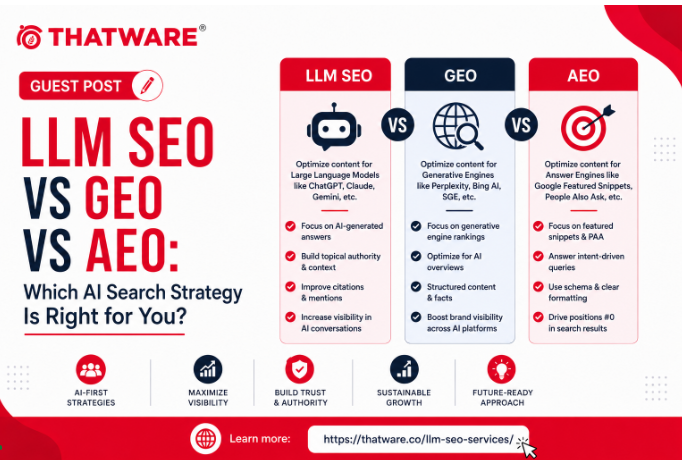
The AI search optimization space has accumulated a small alphabet soup of acronyms in a remarkably short time. LLM SEO. GEO. AEO. LLMO. Each one represents a real approach to a real problem, but the distinctions between them get blurry fast — and most vendors use the terms interchangeably in ways that obscure more than they clarify. Let’s sort it out.
Defining the Three Approaches
AEO — Answer Engine Optimization — is the oldest of the three concepts. It emerged as voice search and featured snippets became prominent, focused on structuring content so it could be directly extracted as an answer. FAQ schema, concise answer blocks, clear definitional content. AEO is about getting your content selected as the answer to specific, often factual questions.
GEO — Generative Engine Optimization — is a broader term covering optimization for AI-generated responses across any generative platform. It overlaps heavily with LLM SEO but often emphasizes the content quality and citation worthiness dimensions over the technical and entity optimization layers.
LLM SEO — Large Language Model SEO — tends to be the most technically grounded of the three. It encompasses not just content quality but the deeper questions of how language models form “views” about brands and topics: entity relationships, training data influence, real-time citation behavior, and structured data that helps models categorize and attribute information correctly.
Which One Should You Care About?
Practically speaking, you want elements of all three — but your emphasis should be driven by your goals and your current gaps. If you’re primarily trying to appear in direct answer formats (voice search, Google’s AI Overview for simple queries), AEO remains highly relevant. If your goal is to be cited and referenced in more complex, multi-sentence AI responses, LLM SEO is the right framework.
The LLM SEO services landscape in 2026 has matured enough that the best providers are integrating all three approaches within a unified strategy. Separating them is mostly useful for understanding the terminology — in execution, they inform each other.
Industry-Specific Considerations
Where you fall on the AEO/GEO/LLM SEO spectrum often depends on your industry. B2B SaaS companies, for example, benefit enormously from LLM SEO because their buyers increasingly use AI tools for research and vendor evaluation. Getting cited in a ChatGPT or Perplexity response to “what’s the best [category] software” is extraordinarily valuable — and the best LLM SEO agencies for SaaS / B2B / eCommerce understand how to pursue that citation share systematically.
eCommerce brands have a somewhat different profile. Product-level AI citations are growing but still secondary to transactional search for many categories. The bigger near-term opportunity for eCommerce is in discovery queries — “what’s a good product for [problem]” — where AI-mediated responses are increasingly influential.
Making the Choice
If you’re trying to decide where to concentrate first, consider the research behavior of your target customer. Do they use AI tools heavily in their buying process? Then LLM SEO is your priority. Are they mostly asking direct factual questions that a voice assistant might answer? AEO is more relevant. Are you a content-heavy brand trying to become a go-to reference on a set of topics? GEO frameworks will resonate.
Most brands in 2026 need a blend — but they need to be strategic about where they concentrate resources rather than spreading thin across every acronym.